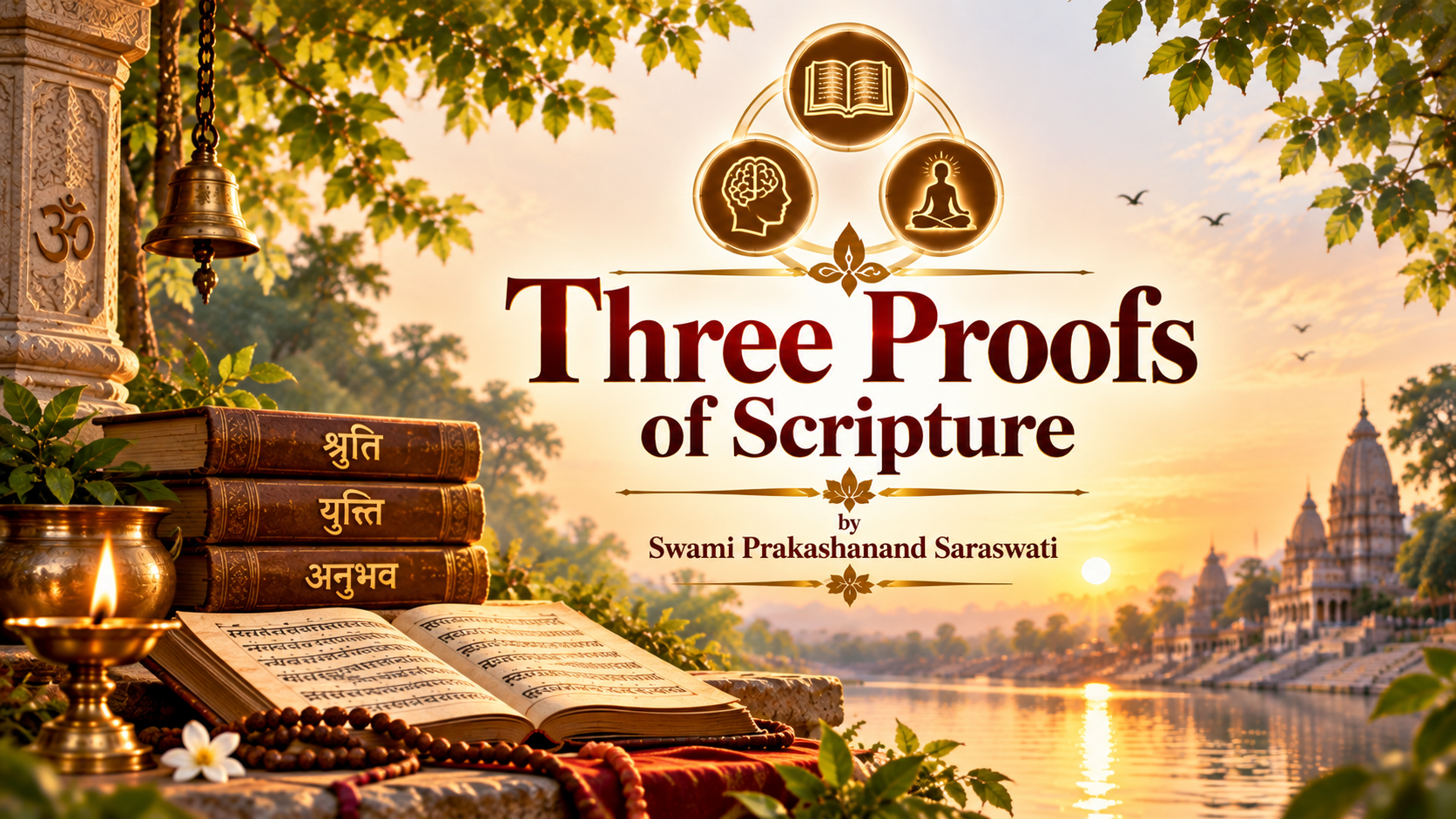
How does anyone argue that a text is Divine rather than simply old? Swami Prakashanand Saraswati, in The True History and the Religion of India*, answers this with a structure borrowed from classical evidence categories: documentary, circumstantial, and eyewitness, or in Sanskrit terms, shabd, anuman, and pratyakch. He applies all three to the Vedas, the Upnishads, the Puranas, the Mahabharat, and the Ramayan. (*Swami Prakashanand Saraswati was awarded the prestigious religious title of “Dharm Chakravarti” in India following the 1999 release of his 800-page book, The True History and the Religion of India: A Concise Encyclopedia of Authentic Hinduism.)
The Documentary Case
Swami Prakashanand Saraswati starts with what the scriptures say about themselves. The Upnishads, as the earliest revelations, state plainly that the Vedas, the Upnishads, the Rishis, and the Sages who carried them were produced and protected by God Maha Vishnu. He cites the Brihadaranyakopnishadas to support that the four Vedas, the Upnishads, the Puranas, history, and their grammar all originated with God directly, and the Chandogyopnishad for calling the Ramayan and Mahabharat, grouped together as Itihas, a fifth Ved in their own right. He also points to the Mahabharat’s own astronomical data, used to date the war itself, as a further layer of internal documentation.
The Circumstantial Case
The second argument rests on scale and precision. Swami Prakashanand Saraswati argues that knowledge this deep, this extensive, and this exact could not have come from ordinary human intellect. He points to the philosophical depth of the scriptures’ account of God and God realization, the sheer scope of the historical material in the Puranas and Mahabharat, and specific numerical claims: the current human civilization beginning 120.5331 million years ago, the earth and the sun in their present form dating back 1971.9616 million years as of 1998, and the origin of this planetary system placed at 155.521972 trillion years. He adds the completeness of Sanskrit grammar, introduced through India’s early sages, to this same list. He explains how precision on this scale is itself evidence, and how knowledge this exact points to a Divine rather than human source.
The Eyewitness Case
The third category is personal experience. Swami Prakashanand Saraswati describes God-realized Saints as those who witness the glory of God directly and write about that association, which is why their writing aligns so closely with the tenets of the original scriptures. He extends this even to accomplished yogis, who he says can visualize celestial gods during deep meditative states without needing a realized Saint to confirm what they experienced.
He gives Surdas as his central example. A Rasik Saint from the Braj region, Surdas is said to have composed more than a hundred thousand songs, or pads, about Krishn’s playfulness at a rate of roughly fifteen to twenty-five a day, sung as he visualized them. Around two thousand of these songs still survive in print today. Alongside these songs, Surdas and saints like him also wrote directly about God’s form, virtues, and the path of God-realization. Swami Prakashanand Saraswati describes these as first-hand testimony to the Divinity the scriptures describe.
Conclusion
Swami Prakashanand Saraswati’s case for scriptural authenticity does not rest on a single kind of proof. It layers the scriptures’ own self-description, the sheer scale and precision of the knowledge they contain, and centuries of Saints who wrote from direct spiritual experience, into one argument. Taken together, in his account, these three proofs are what mark the Vedas, Upnishads, Puranas, Mahabharat, and Ramayan as Divine revelation rather than ordinary historical literature.